Introduction
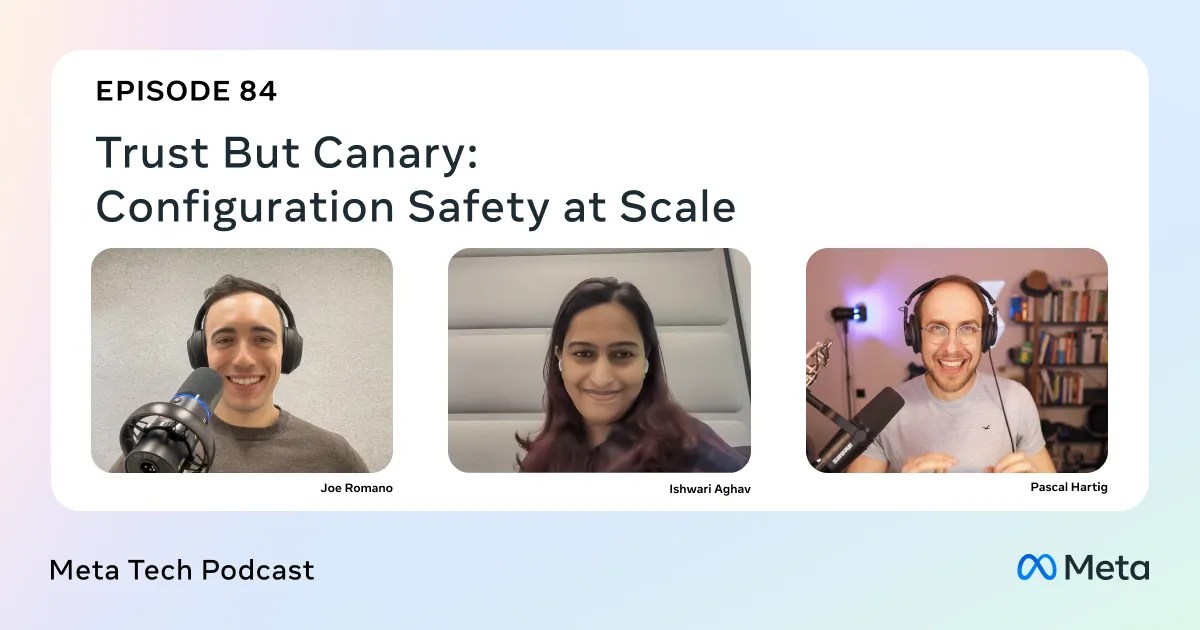
In the world of large-scale software engineering, configuration changes are a double-edged sword. They allow rapid iteration and feature toggling, but a misconfigured flag can bring down a service for millions. As AI accelerates developer speed and productivity, the need for robust safeguards becomes even more critical. In this article, we explore how Meta’s Configurations team ensures safe and reliable configuration rollouts at scale, drawing from a recent episode of the Meta Tech Podcast featuring Ishwari and Joe.
Canary Releases and Progressive Rollouts
One of the core techniques Meta uses to mitigate risk is canarying—rolling out changes to a small subset of users or servers before full deployment. This allows teams to detect issues early without affecting the entire user base. Progressive rollouts gradually increase the percentage of traffic exposed to the new configuration, with automatic rollback triggers if health metrics deviate.
How Canary Testing Works at Scale
At Meta, every configuration change goes through a canary phase. The system exposes the change to a fraction of traffic—typically 1-5%—and monitors key signals like latency, error rates, and resource usage. Only if the canary passes predefined thresholds does the rollout proceed to larger cohorts. This approach reduces blast radius and builds confidence in the change.
Health Checks and Monitoring Signals
Catching regressions early depends on comprehensive health checks and monitoring. Meta uses a combination of synthetic probes and real-user metrics to verify that a configuration doesn’t degrade service quality. Teams define service-level objectives (SLOs) for each pilot experiment, and the system automatically pauses or reverts a rollout if an SLO breach is detected.
Signal Diversity to Prevent Blind Spots
No single metric tells the whole story. Meta monitors a diverse set of signals, including CPU utilization, memory pressure, p99 latency, and custom business metrics. This multifaceted approach helps avoid regressions that might be invisible to a single indicator. For instance, a config change that reduces memory usage but increases error rate would be flagged by the error-rate check.
Incident Reviews: Systems Over Blame
When something goes wrong, Meta’s incident review process focuses on improving systems rather than blaming people. The goal is to identify process gaps, automation deficiencies, or missing monitoring signals that allowed the regression to slip through. This blameless culture encourages engineers to share learnings openly and drives continuous improvement of the rollout infrastructure.

Postmortems That Drive Concrete Changes
Each incident results in actionable recommendations—such as adding a new health check, tightening canary thresholds, or enhancing rollback automation. The Configuration team maintains a feedback loop to ensure these improvements are implemented and validated in subsequent rollouts. Over time, this reduces the frequency and severity of incidents.
How AI and Machine Learning Reduce Alert Noise
Monitoring at scale generates enormous amounts of alerts—many of them false positives. Meta leverages AI and machine learning to intelligently filter and prioritize alerts, drastically reducing noise for on-call engineers. Models learn patterns of normal behavior and flag only anomalies that are statistically significant.
Bisecting Faster with Data
When a regression does occur, quickly identifying the root cause is essential. AI-powered tools can automate bisection across configuration versions, comparing metrics to pinpoint which change introduced the problem. This slashes the time from detection to resolution from hours to minutes, allowing teams to roll back or fix the configuration rapidly.
Conclusion
As software development accelerates with AI, the principles of configuration safety become paramount. Meta’s approach—combining canary deployments, robust health checks, blameless incident reviews, and intelligent alerting—ensures that changes can be rolled out quickly without compromising reliability. For any organization scaling its engineering efforts, these practices offer a blueprint for balancing speed with safety.
Inspired by the Meta Tech Podcast episode “Trust But Canary: Configuration Safety at Scale.” Listen to the full discussion on Spotify, Apple Podcasts, or Pocket Casts.