Meta continues to innovate in user privacy and data security. Their HSM-based Backup Key Vault is the backbone of end-to-end encrypted backups for WhatsApp and Messenger. This system stores recovery codes in tamper-resistant hardware security modules (HSMs), ensuring that neither Meta, cloud providers, nor third parties can access users' message history. Recent updates include over-the-air fleet key distribution for Messenger and a commitment to transparent fleet deployment. Below, we answer common questions about these advancements.
What is the HSM-based Backup Key Vault and how does it protect my backups?
The HSM-based Backup Key Vault is a secure infrastructure that stores recovery codes for end-to-end encrypted backups. These codes are kept in tamper-resistant hardware security modules (HSMs) located across multiple data centers globally. The system uses majority-consensus replication for resilience. This design ensures that only you—not Meta, your cloud provider, or any third party—can access your backed-up message history. Your recovery code is stored in the HSM and never exposed to external services. For more details, see the recent updates that further harden this system.
How did passkeys make it easier to end-to-end encrypt backups last year?
In late 2023, Meta introduced passkey support for WhatsApp and Messenger backup encryption. Passkeys allow users to secure their recovery code using biometric authentication (fingerprint or face ID) or device PIN, replacing the need to remember a complex alphanumeric code. This simpler method still stores the recovery key in the HSM vault, maintaining the same level of security. Passkeys reduce friction, encouraging more people to enable end-to-end encrypted backups without compromising on protection. The underlying HSM infrastructure remains unchanged; only the user-facing recovery method was streamlined.
What two updates recently strengthened encrypted backup infrastructure?
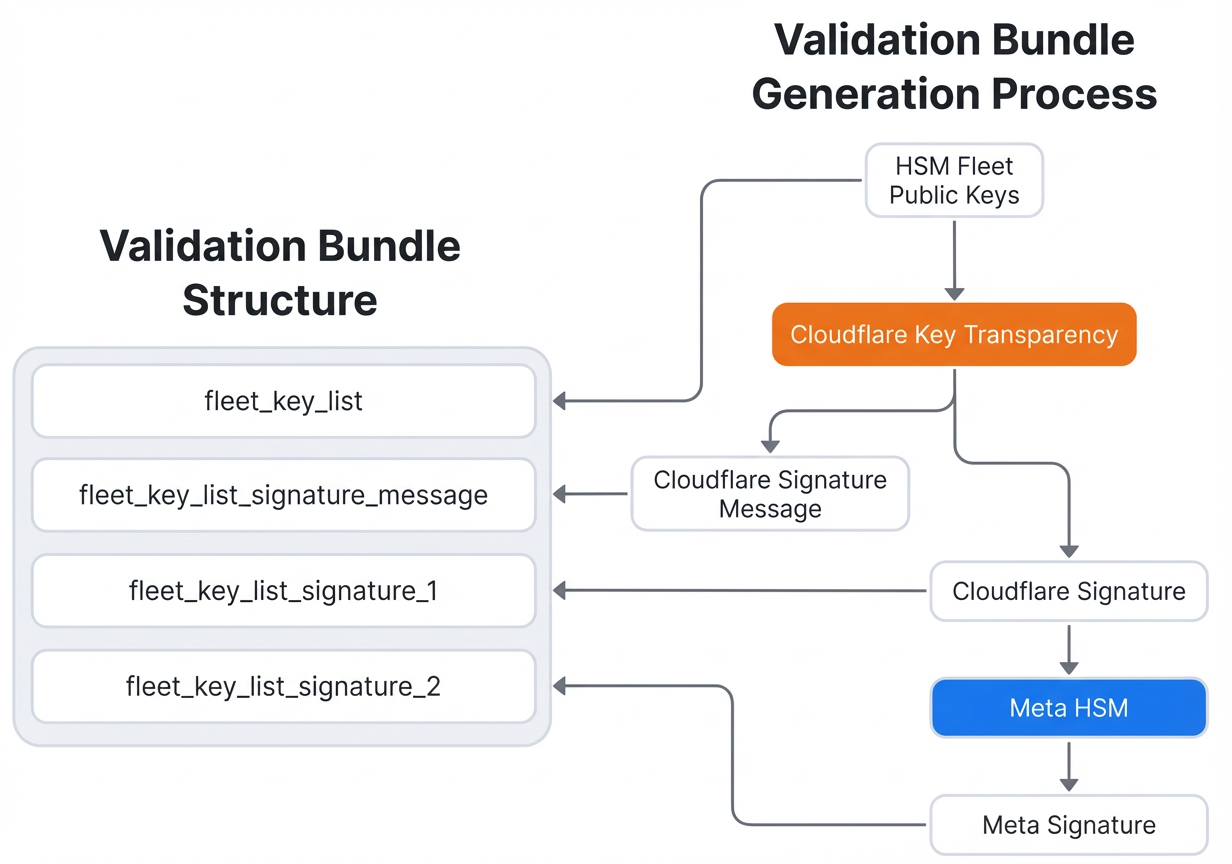
Meta announced two key improvements: over-the-air fleet key distribution for Messenger and a commitment to publishing evidence of secure fleet deployments. The first allows Messenger to verify HSM fleet authenticity without requiring an app update—fleet public keys are distributed in a validation bundle signed by Cloudflare and counter-signed by Meta. The second enhances transparency: Meta now publishes proof of secure deployment for each new HSM fleet, typically every few years. Users can independently verify these deployments by following audit steps in the whitepaper. Together, these updates bolster trust and security.
How does over-the-air fleet key distribution work for Messenger?
To verify HSM fleet authenticity, clients validate the fleet's public keys before establishing a session. In WhatsApp, these keys are hardcoded into the app. For Messenger, where new fleets may be added without an app update, Meta built an over-the-air mechanism. Fleet public keys are delivered in a validation bundle signed independently by Cloudflare and counter-signed by Meta. Cloudflare maintains an audit log of every bundle. This cryptographic proof allows Messenger clients to trust new HSM fleets instantly. The full validation protocol is described in Meta's whitepaper on end-to-end encrypted backups.
Why is transparency in HSM fleet deployment important, and how does Meta demonstrate it?
Transparency proves that Meta cannot access users' encrypted backups—only the user holds the decryption key via their recovery code. By publishing evidence of secure deployment for each new HSM fleet, Meta allows independent verification that HSMs are installed correctly and cannot be tampered with. This commitment, announced in 2024, applies to infrequent fleet deployments (every few years). Anyone can follow the steps in the Audit section of the whitepaper to verify that Meta has not introduced backdoors or unauthorized access. This builds public trust and sets a leadership standard for encrypted backup security.
How can users verify that a new HSM fleet is deployed securely?
Users can follow the detailed audit procedure outlined in the whitepaper, “Security of End-To-End Encrypted Backups.” The process involves verifying cryptographic evidence published by Meta on this blog page for each new fleet. This evidence includes signed proofs from both Cloudflare and Meta, audit logs, and deployment attestations. By cross-checking this information against the expected HSM configuration, users can confirm that the fleet was deployed without tampering. Meta encourages technical users to perform this verification and has made the steps straightforward. No special tools are required beyond standard cryptographic verification software.
Where can I find the full technical specifications of the Backup Key Vault?
The complete technical specification is available in Meta's whitepaper titled “Security of End-To-End Encrypted Backups.” It details the HSM architecture, cryptographic protocols, key distribution mechanisms, and audit verification steps. The whitepaper is publicly accessible on the Meta Engineering blog. Reading it provides a deep understanding of how the Backup Key Vault ensures that your backups remain encrypted end-to-end, inaccessible to anyone without your recovery code. For the latest updates, check Meta's official announcements and the engineering blog.