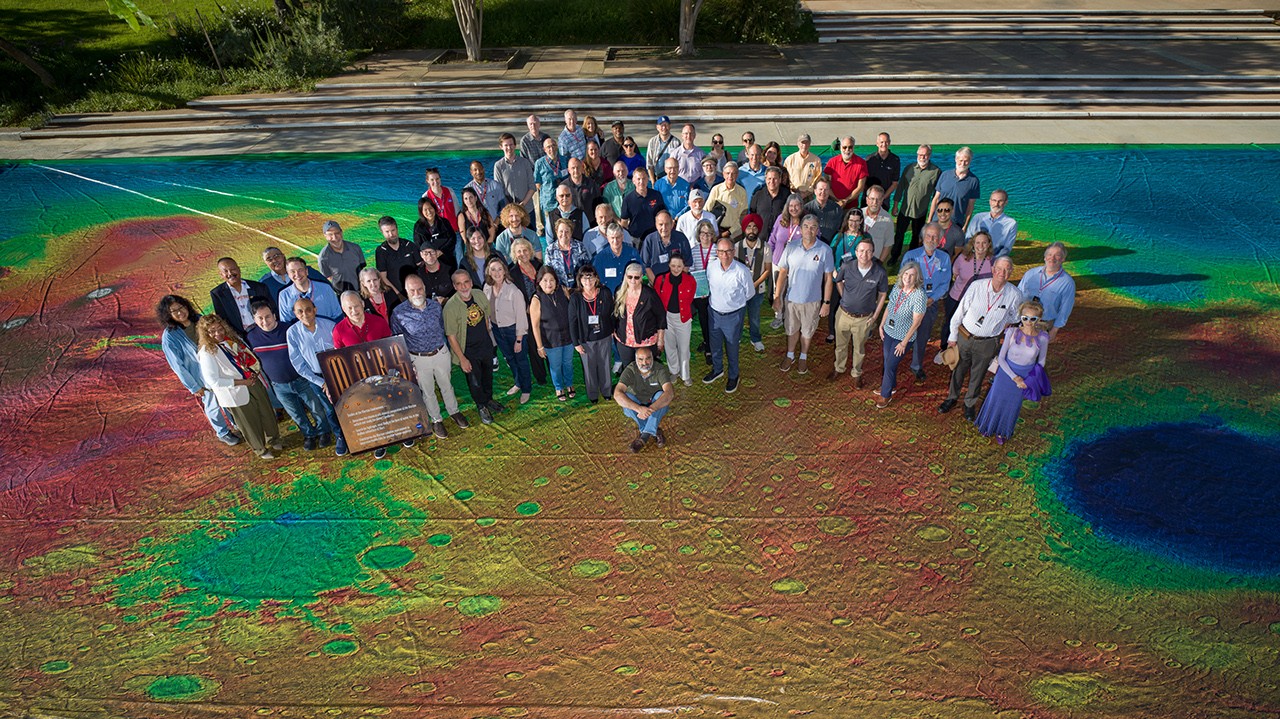
In April 2026, NASA's 2001 Mars Odyssey orbiter mission marked a remarkable 25 years since its launch on April 7, 2001. To commemorate this milestone, past and present team members gathered for a special event that featured a stunning giant global map of Mars. This map, created from data collected by the spacecraft's THEMIS infrared camera, served as both a tribute to the mission's longevity and a visual testament to its scientific achievements. Below, we explore the details of this celebration and the mission's enduring legacy through a series of questions.
1. What event did the Mars Odyssey team hold on April 15, 2026?
On April 15, 2026, team members from NASA's 2001 Mars Odyssey orbiter mission—both current and former—convened at the Jet Propulsion Laboratory (JPL) in Southern California to celebrate the spacecraft's 25-year launch anniversary. The highlight of the gathering was the unveiling of a giant global map of Mars, which was printed on a large banner or display. This map was not just a decorative piece; it represented the extensive scientific data collected by Odyssey's Thermal Emission Imaging System (THEMIS) over a quarter century. The event served as a reunion for the dedicated team that has overseen the mission since its launch on April 7, 2001. Team members shared stories, reflected on challenges, and celebrated the orbiter's ongoing operational success. The celebration underscored the collaborative spirit of the mission and its significant contributions to Martian science.
2. Why was a global map of Mars chosen as the centerpiece for the celebration?
The global map of Mars was a fitting symbol for the 25-year celebration because it encapsulated the core scientific achievement of the Odyssey mission. The map, created from infrared images captured by THEMIS, provides a comprehensive view of the Martian surface, revealing mineral compositions, thermal properties, and geological features. Over the years, Odyssey has mapped the entire planet multiple times, enabling scientists to study seasonal changes, water ice deposits, and landing site selection for rovers like Spirit, Opportunity, and Curiosity. By rolling out this giant map, the team visually demonstrated the breadth of data collected and the mission's role in creating foundational datasets for Mars exploration. It also served as a reminder of how far the mission has come—from its original goals to its extended operations that continue to support current and future missions. The map is a tangible representation of the mission's legacy.
3. How was the global map created using Odyssey's THEMIS instrument?
The global map featured at the celebration was built from thousands of images taken by THEMIS (Thermal Emission Imaging System), a multi-band infrared camera aboard the 2001 Mars Odyssey orbiter. THEMIS captures thermal infrared radiation emitted by the Martian surface, allowing scientists to identify different rock types, minerals, and surface temperatures. To create a global mosaic, individual THEMIS image strips are carefully stitched together using specialized software. Each strip covers a swath of the planet, and over many orbits, the instrument accumulates coverage of the entire globe. The process involves correcting for variations in sunlight, viewing angle, and temperature to produce a seamless, calibrated map. The result is a high-resolution thermal infrared atlas that has been used in countless studies. For the 25-year celebration, a special giant-format version was printed to highlight the mission's unique contribution to planetary science.
4. What is the significance of the 25-year milestone for the Odyssey mission?
The 25-year milestone is extraordinary for any spacecraft, especially one orbiting another planet. NASA's 2001 Mars Odyssey was originally designed for a prime mission of about two Earth years, but its robust design and innovative engineering have allowed it to operate far beyond expectations. This longevity places Odyssey among the longest-serving active missions at Mars. Over 25 years, the orbiter has not only completed its primary science goals—searching for water and mapping the Martian surface—but also provided critical support for other missions. It acts as a telecommunications relay for rovers and landers, sending data back to Earth. The 25-year mark represents a testament to the dedication of the operations team, the reliability of the spacecraft, and the enduring value of long-term observations. It also highlights how NASA's investment in planetary exploration yields decades of scientific return, far exceeding initial plans. The celebration honored this remarkable achievement and the people who made it possible.
5. Where did the celebration take place and who attended?
The celebration was held at NASA's Jet Propulsion Laboratory (JPL) in Southern California, the facility that manages the Mars Odyssey mission. JPL is known for its role in numerous robotic space missions, and it provided a fitting venue for the reunion. Attendees included both current team members who continue to operate the spacecraft and process data, as well as alumni who worked on the mission during its earlier phases—some who were involved from the very beginning. This mix of veterans and newer staff created a sense of continuity and shared history. The event featured speeches, a cake, and of course the centerpiece global map. The intimate gathering allowed for personal interactions and storytelling, reinforcing the human element behind the robotic explorer. JPL's role as the mission's lead institution underscores the collaborative effort with other NASA centers, universities, and international partners who have contributed to Odyssey's success over the years.
6. What has Odyssey contributed to Mars exploration over 25 years?
Since its launch on April 7, 2001, the 2001 Mars Odyssey orbiter has made profound contributions to Mars science and exploration. Its primary objectives were to search for evidence of past or present water and to characterize the mineral composition and radiation environment of the planet. Using THEMIS, it produced the first global thermal infrared map, revealing subtle variations in surface minerals and identifying vast deposits of water ice near the poles. These discoveries helped pave the way for subsequent missions. Additionally, Odyssey's Gamma Ray Spectrometer detected hydrogen, indicating abundant shallow water ice. Beyond science, Odyssey has served as a critical communications relay for NASA's Mars rovers—Spirit, Opportunity, Curiosity, and Perseverance—transmitting data back to Earth. It has also supported landing site assessments for these missions. After 25 years, the orbiter remains operational, continuing to provide valuable meteorological and surface observations. Its legacy includes foundational datasets that have shaped our understanding of Mars and enabled future exploration.